
Bicycles and ferries
There are some ferry services out there, and some timetable slots, which don’t take either foot passengers or bicycles (despite taking passengers with motorised vehicles including motorbikes), and one ferry service which does takes bicycles but not foot passengers – see the campaigns page for more on improving access for foot passengers and cyclists.
However, for all the routes listed on the ferry options page on this website, there is normally a way to bring a bicycle on them, and bringing bikes on ferries is generally easy and doable. Normally there is no need to unpack your gear or pannier bags off your bike either.
If you are travelling with a normal bike on a ferry, there is normally an option in the online ferry booking form where you can select that you are travelling with a bicycle. If you are travelling with a folding bike, you may decide to book it as a normal bicycle, or to fold and pack it up as luggage and book the ferry as a foot passenger (which may be cheaper).
Different ferry routes treat bicycles differently:
Bike-as-luggage approach: On many routes, including Dublin-Holyhead and Belfast-Liverpool, when you arrive at the ferry terminal, you go to the check-in area for foot passengers and check the bicycle in as luggage – a bag or box is not required, and this applies to all bicycles (not just folding bicycles). In these cases, the port authorities or ferries do not allow you to cycle onto the ferry, although that is the way motorbikes get on the ferry. The bicycle will be transported to and on the ferry in a truck or van, with other luggage, while you yourself are treated as a foot passenger in the meantime. On arrival, you will disembark as a foot passenger, and you will get your bicycle back in the ferry terminal – the bike may be wheeled out by staff for you to collect in the luggage collection area, or may come out on a conveyor belt if it is folded in a bag or box.
Bike-as-vehicle approach: However, on other routes, including Ringaskiddy Cork to Roscoff, Rosslare to Bilbao and Belfast to Cairnryan, you do cycle onto the ferry. In these cases you cycle to the vehicle check-in point. Once you get to the ferry you generally dismount and walk with your bike, and there are straps where you secure your bike in the vehicle area of the ferry. You disembark by walking off the ferry with your bike, or cycling off the ferry. This video from Andrew shows the process of cycling to/from the port and cycling on/off the ferry at Rosslare https://www.youtube.com/watch?v=_YboSVjrzmI and this video from Philip shows cycling off the ferry at Belfast https://www.youtube.com/watch?v=QDoq7lQbxaA.
See also the page on Ferry travel – on the day for some details about cycle paths to/from individual ports.
Bicycles and trains/buses in Ireland
From Elaine: I travel quite a bit with a folding bike on public transport in Ireland. To get your folding bike on a bus, it can be useful to have a bike bag with you, but not always needed. Bus Eireann specifically allows folding bikes, if the driver does not know this you can point out the policy on the website https://www.buseireann.ie/bicycles. Coach companies typically allow bicycles (folding and non-folding) in the hold under the coach. City buses such as Dublin Bus will normally refuse normal bikes and may refuse a folding bike if it is not in a bag and can’t be put on the luggage rack. Local Link rural buses sometimes refuse non-folding bicycles but I have been able to get folding bike on them.
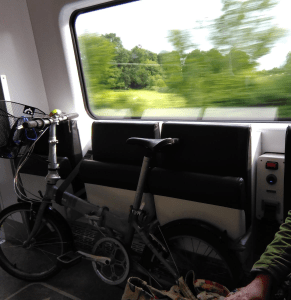
Irish Rail have space for bicycles on national trains, sometimes this can be in a separate windowless carriage at the very end of the train, but more recently there are modern trains with fold down seats and bicycle places. Lifts to get from one platform to another at train stations can be an issue as they are mostly sized for wheelchair users rather than bicycles.
Bicycles and trains in Britain
From Elaine: I have travelled a good bit by train in Britain with a folding bike and haven’t had problems. Sometimes trains can be replaced by buses temporarily, and that is normally fine for folding bikes (but not for normal bikes). You normally don’t need a bag for your folding bike, but it can be useful to have one with you in case you are asked to put the folding bike in a bag for some services.
From Darach: My experience with traveling with a regular bike on trains in Britain is that you must book your bike when travelling on some long distance routes, such as Holyhead to London, as there is limited availability – you can do this even when using a rail and sail ticket, you can reserve a bike place only. Traveling from London to Harwich with a bicycle on a train, I didn’t have to book a bike place because it was not rush-hour (but you might have to during rush hour). I got this information for particular routes and trains by looking at nationalrail.co.uk using the journey planner/ticket purchasing tool and then pressing + for more information on the route and trains. There is more information on combining bicycles and trains in Britain here www.nationalrail.co.uk/on-the-train/train-travel-with-bicycles/ .
Bicycles and buses in Britain
National Express and Eurolines (who run Dublin-London buses) say on their websites that you can only bring folding bikes in bags on these services, but not full bikes (https://faq.nationalexpress.com/s/article/Can-I-take-my-bicycle-1581438954893). Hannon Coach (who runs Belfast-Glasgow bus service) does carry normal bikes.
Bicycles and the Eurostar
You can bring a normal (non-folding) bicycle on the Eurostar to Brussels but not to Paris. You pay an extra fee, the bicycle is checked in at a different desk to the people check-in, staff members put it in a special luggage carriage, and you wait for your bicycle to be brought to you on the other end by a member of staff (which can take a while – factor this into any connection times).
You can bring a folding bike on the Eurostar but only if it packed in a bag (they are strict on this). A folding bike in a bag goes through the security systems in the normal way like other luggage, and can be loaded into the large luggage racks at the end of every carriage, so no waiting for it on arrival.
Bicycles and trains in Europe
From Elaine:
I have travelled in several countries in continental Europe with a normal non-folding bicycle (loaded up with camping gear), combining cycling with train and some bus travel. To do this, you often need to take regional trains rather than high speed trains. (It is often not allowed, or difficult, to book a non-folding bike on high-speed trains). I have travelled this way in Netherlands, Belgium, Germany, Switzerland, Italy, France and Spain and have been able to travel quite long distances this way, avoiding high speed trains, as bike-carrying trains also travel the same routes.
The best website/planning app I have found for planning this travel is DB https://int.bahn.de/en/ – it is the German train app but it actually covers a lot of mainland Europe. It has a “Bicycle transport possible” tick box, so you can quickly find train routes which allow bicycles (non-folding), although I did find that in Spain it told me I couldn’t bring bikes on trains where I actually could, but for other countries it seems to have accurate information.
Here are some good resources about travelling with a bicycle by train in Europe:
- https://cycling-on-rails.com/ – a great guide developed by an experienced bike-on-train traveller
- https://wobblyride.com/2024/04/30/taking-a-bicycle-on-train-in-europe/ Page on a website by Joanna, a Polish bicycle traveller:
 ByLandAndSea.ie
You must be logged in to post a comment.