
Getting to the port and travelling by ferry
Ferry check-in and luggage
You can check in luggage on most ferries, and carry other luggage with you. At many ports, you don’t walk onto the ferry – the check-in luggage reaches the ferry in a truck, and you will reach the actual ferry via a shuttle bus from the terminal. At your destination terminal the check-in luggage is retrieved from a conveyor belt.
Check-in is normally about 40 minutes in advance, best not to be late, but they will often still let you on even if you are a little late.
If you are short on time on arrival, waiting for luggage can mean a delay, so you can consider carrying all luggage with you and not checking it in, to avoid that.
See also our page on bringing bikes on ferries.
On the ferries
The ferries generally have restaurants, some have children’s play areas, and you can go outdoors on deck. Most have comfortable sofas where you can stretch out and sleep if you wish. When you get on the ferry, it can be a good idea to pick a “base” quickly – high on the list of considerations can be proximity to charging, space to stretch out if you’re tired, and tables! As well as either distance from or proximity to the children’s play area, as desired! Some also have little cinemas – children need to be accompanied by an adult in these. Some also have games areas.
You can enjoy the restaurant food, but if on a budget or if you have special requirements, you can also travel with your own packed food and eat it at the tables. Ferry breakfast/ snack prices have been upwards of three times the price for cereals, croissants, and sandwiches compared to standard shops upon docking. However meal prices and drinks are not as marked up. Still, a pre-prepared sustenance plan will go a long way to avoid additional expenses.
You won’t have your normal mobile internet while at sea. It is a good idea to switch off mobile data on your phone while on the ferry to prevent high charges by your mobile network operator, as well as running down phone battery (searching for signal is a high draw on phone power). Most ferries have an on-board wifi, which is often free for the first while, then you have to pay for more. Of course you can just chill out and stay disconnected for the journey, or have some pre-downloaded material on your devices. Often these services ask you to enter your email to use them, however to avoid marketing and unwanted junk mail you can simply enter a false email and they connect all the same.
On longer or overnight ferries if you have booked a cabin or a reclining seat that gives you a base.
Ports
Dublin Port
Note that Dublin Port has separate terminals for Irish Ferries (which is also the terminal for Steam Packet to Isle of Man) and Stena Line, these two terminals are 750m apart – so make sure you go to the right one! Both have indoor waiting areas, the Stena waiting lounge is particularly comfortable.
Dublin Port is accessible from Dublin city centre on foot using
- Bus 53
- Ferry shuttle service run by www.nolancoaches.ie/ferry-link
- Taxi (including taxi hailing apps such as Lynx and FreeNow)
There are two major intercity train stations in Dublin – Dublin Heuston for travel to the South West and South, which is 8 km from Dublin Port, and Connolly Station for travel North, North West and South, which is a little less than 6 km from Dublin Port.
If you are travelling by bicycle, you can cycle between Dublin Port and Dublin city centre – there is a protected cycle lane part of the way, although it does come to a dead end at one point. If travelling by bicycle to/from the port from the North of Dublin city, you might like to use this greenway along the seafront www.dublinport.ie/greenway/ .
Further information about transport to/from Dublin Port: www.dublinport.ie/to-from/
If you are travelling on the direct Dublin-London bus route mentioned above, you can get on/off the bus either in Busáras (Dublin’s central intracity bus station) or at a few other stops, so you don’t have to make your way to the ferry terminal independently.
From Aaron: If you are driving or getting a lift to Dublin port there is a toll at the port tunnel *Note this can be avoided!* which has different prices for on-peak and off-peak times:
- Peak Time Toll €13 – Southbound – Monday to Friday 06:00-10:00
- Peak Time Toll €12 – Northbound – Monday to Friday 16:00 – 19:00
- Off-peak Time €3.50 – All other times
Avoiding this hearty toll: When traveling to the ferry from the M50 North, if factoring in extra time you can ignore the tunnel exit and continue towards Coolock. You come to a huge roundabout and can then take a more local route to the Ferry Port. This can be a stressful situation when traveling during early morning city traffic so inspect and plan for this route in advance.
Rosslare Europort
From Seb: The train station is a 10-minute walk from the Rosslare ferry terminal, with trains from Dublin and a few stops in-between (including on the Dart route), taking 3 hours. Only four trains run each day, so check the times in advance. There are also buses to Rosslare Europort, there is information here www.rosslareeuroport.ie/en-ie/location/ . The ferry terminal is located well away from Rosslare town. You can access a little beach near the port but don’t expect to do anything much there and bring food if needed.
This video from Andrew shows practical information about Rosslare port at the beginning and the end of the video https://www.youtube.com/watch?v=_YboSVjrzmI .
See also www.brittany-ferries.ie/ferry-routes/planning/ports/rosslare
Belfast Port
Coming soon – if you have material to write here, let us know!
Larne Port
Coming soon – if you have material to write here, let us know!
Cork Ringaskiddy Port
From Seb: The ferry port in Cork is quite isolated and located in Ringaskiddy, a small town connected to Cork via a regular bus service that takes a bit under an hour. The bus stop is about 15 minutes walk from the ferry port and it arrives in the centre of Cork, which is another 15 minutes walk away from the train station (Cork Kent). Ferries to/from Ringaskiddy offer a beautiful view of Cobh on its way, to get you in the holiday spirit or to welcome you back.
See also www.brittany-ferries.ie/ferry-routes/planning/ports/cork
Holyhead Port (Wales)
Holyhead port has the same terminal for both Stena and Irish Ferries, and the train station is right next to the ferry terminal – you don’t even have to leave the roofed area. The ferry terminal has an indoor waiting area with a shop.
Pembroke Port (Wales)
From Elaine: Pembroke port has an indoor waiting area which is open around the times the ferries are coming and going. The port is located about 1.1km from the train station.
Fishguard port (Wales)
Coming soon – if you have material to write here, let us know!
Cairnryan port (Scotland)
Coming soon – if you have material to write here, let us know!
Liverpool port (England)
Coming soon – if you have material to write here, let us know!
Cherbourg port (France)
From Seb: There is a shuttle service from the ferry terminal to the centre of Cherbourg and the train station, with a bus stop near the entrance of the ferry port, but there is no personnel on-site available, only a phone number. It is quite possible to walk to the centre of Cherbourg and its train station (about 40 minutes walk), which is my preferred option. From Cherbourg you can get direct trains to Paris (gare Saint Lazare, 3¼ hours) or other destinations.
Martin has lots of details about how to get from Cherbourg Port to Cherbourg train station here y25.ie/blog/2024-05-20-Cherbourg-Ferry-Port/ and here y25.ie/blog/2024-04-25-Gorey-To-Vienna/
See also www.brittany-ferries.ie/ferry-routes/planning/ports/cherbourg
Roscoff port (France)
From Seb: You can get to/from Roscoff via Morlaix, which is on a direct TGV line to Paris (gare Montparnasse), taking 3¼ hours. There are buses between Morlaix and Roscoff taking one hour or you can take a taxi in 25 minutes. You can get tickets for the Morlaix-Roscoff bus (confusingly, the French word for bus/coach in this case is “le car”) at the same time as your train ticket if you use a multi-company booking system such as TrainLine or just pay the driver when boarding. For info on these buses see the BreizhGo website.
The ferry port is about 20 minutes walk from the center of Roscoff and its shops, bars and restaurants. Roscoff is a pretty seaside tourist town typical of Brittany where you can enjoy a walk or a cycle along the beautiful coastline if you have time (bike rental in the sailing port next to the ferry terminal).
See also www.brittany-ferries.ie/ferry-routes/planning/ports/roscoff
Dunkirk port (France)
Martin has some information about Dunkirk Port in the return journey part of this blog y25.ie/blog/2023-07-21-Gorey-To-Rotterdam/. Note the ferry from Dunkirk does not take foot passengers, although it does take pedal cyclists (as well as motorised vehicles), and the port is not very foot-passenger friendly.
Bilbao Port (Spain)
There is a cycle path to Bilbao port.
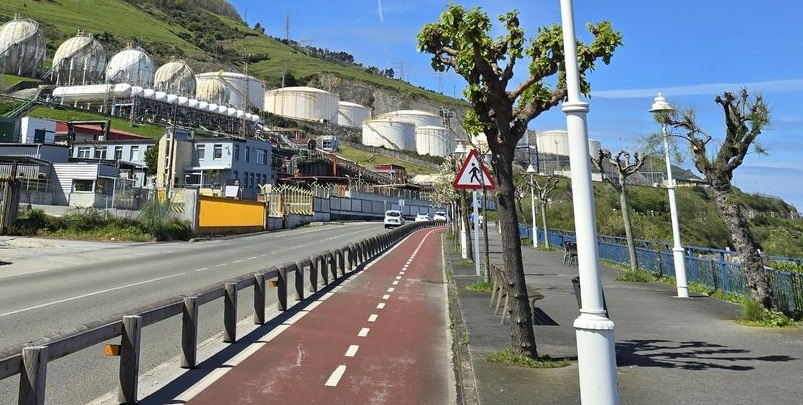
Bilbao also has a train station.
Further information: www.brittany-ferries.ie/ferry-routes/planning/ports/bilbao
Santander Port (Spain)
See www.brittany-ferries.ie/ferry-routes/planning/ports/santander
 ByLandAndSea.ie
You must be logged in to post a comment.