
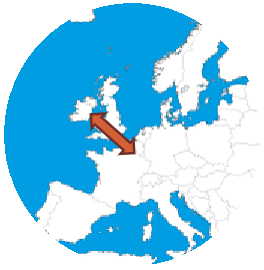
Besides ferries which go directly between Ireland and mainland Europe, you can also travel via Britain to/from mainland Europe – this has lower emissions as it involves shorter ferry trips. You can travel between Britain and mainland Europe either via the Eurostar channel tunnel train, or by using a second ferry between Britain and mainland Europe.
Eurostar route – Dublin to France / Belgium / Netherlands by ferry and train
Journey length
From Elaine: I have travelled using the Eurostar many times (more often than I can count) between Dublin and Paris, Dublin and Brussels and Dublin and Rotterdam/Amsterdam, with and without children (from toddlers to teenagers), and with and without my folding bike (never with my folding bike and children at the same time though 🙂 ). I often go straight through when by myself, but break the journey up somewhere in Britain (such as near Crewe or Chester or in London) if with my children, but I once did Paris to Dublin in one day (early morning to midnight) with my two tweens.
Michael has written out some handy timetable options for this journey here: pidgeon.ie/coming-to-dublin-by-train-and-ferry/
Martin blogs about his trip to Rotterdam via Dublin-Holyhead ferry and the Eurostar here y25.ie/blog/2023-07-21-Gorey-To-Rotterdam/
Eurostar destinations
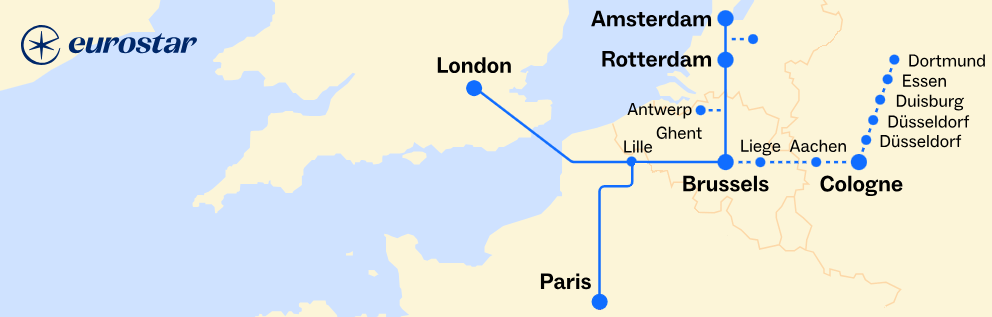
The Eurostar operates direct between London and Lille, Paris, Brussels, Rotterdam and Amsterdam. The services are very frequent – the London-Paris route operates almost every hour (18 times a day), about half of those stop in Lille on the way. The Eurostar to Brussels/Rotterdam/Amsterdam operates 9 or 10 times a day. For Amsterdam or Rotterdam, the trains at some times involve changing in Brussels and at other times you go direct. You can also book to any train-accessible city or town in Belgium with a Eurostar ticket. To Dusseldorf it is less frequent, normally with a change in Brussels. Of course once you are in any of these places there are countless trains going everywhere in Europe.
Booking the Eurostar
Eurostar is cheaper the earlier you book and very very expensive at the last minute. So if you are taking the Eurostar best to book early. Best to book through the Eurostar website www.eurostar.com
If you buy an interrail ticket (highly recommended – www.interrail.eu ), you can use it to cover the Eurostar, but you also have to book your seat on the Eurostar for the date you wish to travel, and there is a Eurostar seat reservation fee.
Moving between Euston and St Pancras stations in London
The Holyhead – London train terminates at Euston Station, but the Eurostar goes from St Pancras International Station. Euston and St Pancras stations are about 700m apart.

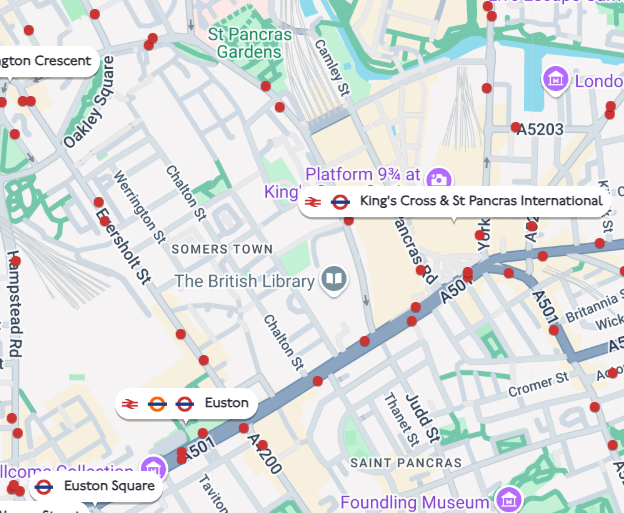
Options for going between St Pancras International and Euston Station are:
- Walk 700m
- Cycle your own bicycle if you have one with you (see bringing a bike)
- By tube (London Underground) between Kings Cross / St Pancras underground station and Euston Underground station, using the Northern Line or Victoria Line. Note you are not looking for “Euston Square” underground station (which is 300m away from the intercity Euston Train Station)!
- By London bus – 73, 30, 205, 390 buses all run from St Pancras International bus stop A to Euston Station stop H, which is 150m from Euston station
- Taxi
Regardless of the method of going from one to the other, you will need to be able to carry or possibly wheel your luggage.
If you intend travelling by tube or London bus, you will need one card for each person (including children aged 11 or more) – this can be a credit/debit card or an Oyster card. If you have children over 11 and want to access the lower child fares, you will need an Oyster card, or you can simply use a spare normal credit/debit card for a child and pay the adult fare for them. You can buy an Oyster card and get it loaded up and reset to child fares with the help of staff at the underground station – the central stations are well staffed with helpful people who stand near the ticket machines. Children under 11 go free on London transport. If you go to the trouble of buying Oyster cards, remember to bring them on your next trip to London to save you doing it again! You can get more information on the Transport for London webiste.
Travelling on the Eurostar
Checking into the Eurostar is a lengthy process especially on the London side, involving security checks, passport checks and long walks and winding queues from one place to another. Sometimes there is not enough seating in waiting areas too so you can be left standing or sitting on the floor for short times. Simply getting out of St Pancras station when you arrive on the Eurostar is also quite a lengthy walk in itself!
The Eurostar trains themselves are very comfortable, with phone and laptop charging facilities etc. Internet is not good for parts of the Eurostar journey, so plan to be offline for parts of the journey.
See also our page on bringing a bike on the Eurostar.
Ferries from Britain to continental Europe
There are also a large number of ferry connections from various places in Britain to various places in Netherlands, France and Spain. The shortest to France is Dover-Calais, and the shortest to Netherlands is Harwich-Hook van Holland.
This map is from https://flightfree.co.uk/post/how-to-travel-by-ferry/ though it may not be fully up to date.
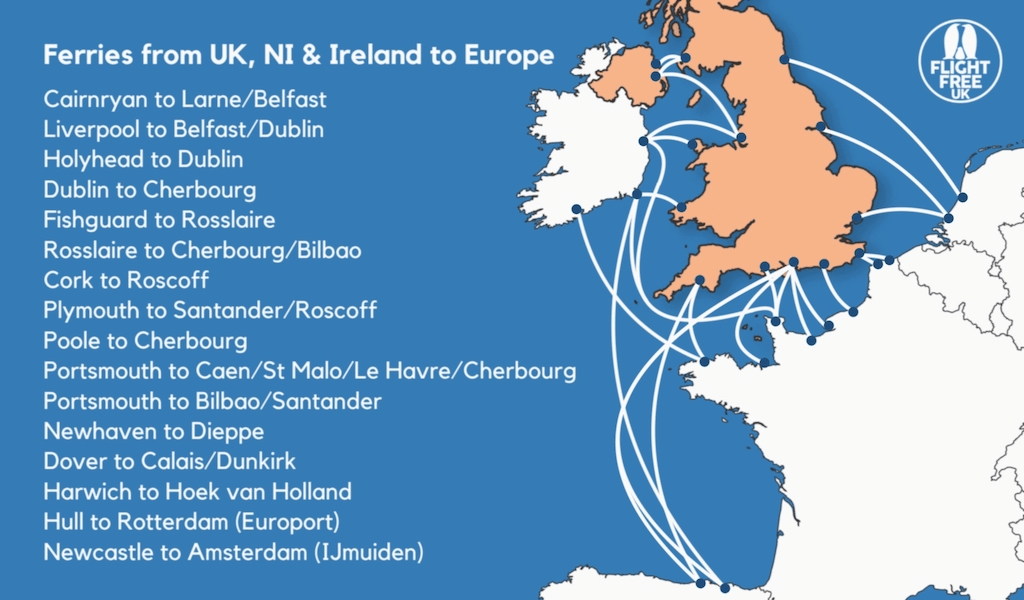
You can also see the routes divided out by ferry company in the ferry options page.
From Elaine: Some Britain-Continental Europe ferries I have experience with include:
- The Dover-Calais ferry. It is only 90 minutes. There are a number of ferry companies operating this route but only P&O Ferries allows foot passengers and cyclists. There are nice views of the cliffs of Dover. It is cheaper than the Eurostar and there are train stations in both Dover and Calais, but distances between port and train station are 1.3km in Dover and 3.5km in Calais.
- The Harwich-Hoek Van Holland ferry – this can be done as an overnight trip with a cabin so doubles as accommodation for the night.
 ByLandAndSea.ie
You must be logged in to post a comment.